Dune Grass or Bare Sand: Two Very Different Shore Surfaces
Dune grass or bare sand reveals how wind shapes dune surfaces. Learn to read ripples, deposits and sheltered edges without guessing at their cause.
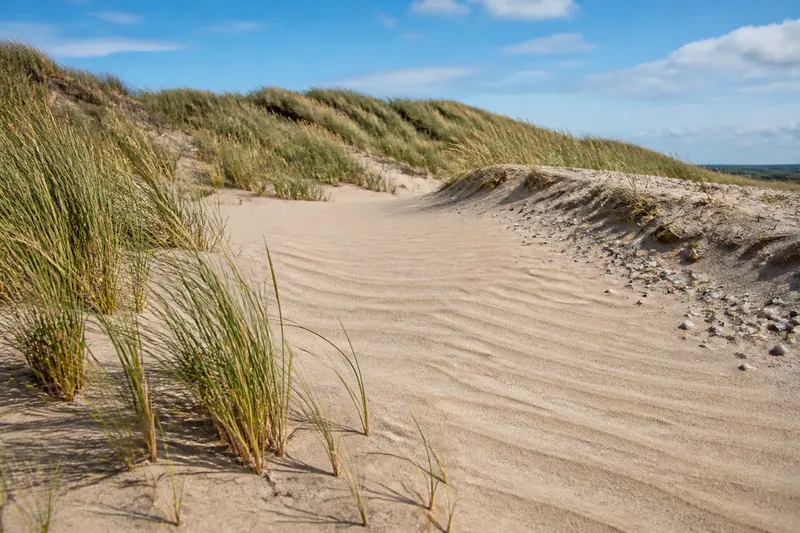
At the foot of a dune, grass blades lean inland while thin ripples cross a clean patch of sand. Comparing dune grass or bare sand can reveal how wind moves across a shore, where grains settle and how the shape of a slope alters exposure.
Surface clues
Grass stems and leaves interrupt wind close to the ground. Some grains settle around their bases, forming small mounds between the blades. The sheltered pockets are local; a tuft does not calm an entire slope.
Across bare sand, fewer obstacles interrupt the airflow. Loose grains may form ripples or shallow hollows, while damp or compacted patches can appear smooth. A bare area alone does not tell you whether sand has been removed, deposited or simply left open.
Look at texture as well as colour. Ripple crests and fresh streaks suggest loose grains have moved; a firm surface without those marks offers less evidence of recent transport.
Grass and shelter
On a vegetated slope, inspect the pattern of sand around individual stems. Deposits on one side of a clump can indicate where airflow has been interrupted, though the direction of the wind and the shape of the slope also matter.
Grass changes the structure of the ground, creating shaded spaces and dividing open sand into smaller patches. Dense clumps form a more continuous screen than scattered tufts, which leave wider channels between them. The arrangement is often more informative than the amount of green visible from a distance.
On a breezy day, grass tips can show changes in airflow near a bend or ridge. Treat them as a local clue, not a complete account of the wind across the whole dune.
Bare sand movement
Ripple crests, fresh streaks and a thin drift against a shell or pebble make movement on open sand easier to trace. Their position relative to a ridge, hollow or vegetation edge helps show where grains travelled and where they paused.
A broad open face has little to interrupt wind at ground level, but its appearance cannot identify why vegetation is absent. Exposure, slope shape, recent weather and disturbance are possible factors. Describe the visible pattern first and leave its cause unresolved unless the evidence is clear.
Compare the open patch with a nearby grass edge. If ripples weaken as they approach stems, the change marks a transition between exposed sand and a more sheltered surface.
Edges and ridges
The boundary between grass and bare sand can make small changes easier to see. A sharp edge may have a lip of deposited grains or exposed roots. A gradual edge may weave through scattered shoots and ripples, where the plants interrupt airflow unevenly.
Ridges redirect wind. The slope facing into a breeze may have more active surface texture, while the lee side can collect deposits behind the crest. These differences can occur close together, so compare them from firm ground rather than stepping onto fragile plants.
Say you are looking from an established path at a bare oval beside a low ridge, with thicker grass inland. In this invented situation, you note crisp ripples across the oval and a thin drift against the ridge. Your field note can read, “Ripples on open patch; grains gathered at ridge; grass thickens inland.” The result is a clear description of movement and shelter, without claiming to know how the oval formed.
Questions about dunes?
Does grass mean sand is stable?
Not necessarily: sand can still shift between clumps or along an exposed edge. Record the vegetation and visible deposits as separate observations.
Does bare sand mean erosion?
No. An open patch may show movement in either direction, or it may simply be exposed. Ripple shape and the locations where grains collect offer clues, but do not establish a cause on their own.
What belongs in a field note?
Record the cover pattern, slope position, visible ripples, nearby obstacles and wind direction if it is apparent. A small sketch can show the relationship between an edge, ridge or hollow more clearly than a string of adjectives.
How can I compare surfaces safely?
Use an established path or firm open ground as your viewing point, and binoculars for distant detail. If a view requires crossing fragile vegetation or an unstable ridge, choose another viewpoint instead.
Useful field comparisons
A side-by-side comparison is most useful when it links each surface to its setting. Check the following observations and use them to decide what to record next:
- Check whether ripples cross the bare patch; if they are clear, describe it as visibly textured by moving grains, but if they are absent, note a smooth surface without inferring that no movement occurs.
- Check whether sand gathers around grass stems; if small deposits are present, record local shelter, but if they are absent, compare another clump or note that no deposit is visible.
- Check whether the sand is loose or compact; if grains appear loose, note that surface movement is easier to observe, but if the ground looks firm, describe its texture without calling it inactive.
- Check where the grass edge meets open sand; if the boundary is sharp, record a distinct transition, but if shoots are scattered through the sand, describe a gradual, mixed edge.
- Check the patch’s position relative to a ridge; if it lies on the wind-facing slope, compare its texture with the lee side, but if the wind direction is unclear, record the position without assigning exposure.
- Check whether grains collect against a shell, pebble or ridge; if a drift is visible, note its location, but if there is none, describe the surface without assuming grains have not moved.
Keep the comparison tied to place and conditions. “Ripples below the ridge, fading beside grass” says more than “windy dune” because it records where the visible change occurs. Dune grass or bare sand is useful to read as a relationship between vegetation, moving grains and slope shape, not as a verdict about the whole shore.
A view from a path may show less detail than a close inspection, but it preserves the pattern under observation. Let the limits of that view remain part of the field note.