Why Sand Grains Sort Themselves Along a Beach
Why sand grains sort themselves along a beach depends on water movement and sediment supply. Learn to read bands by texture, position and composition.
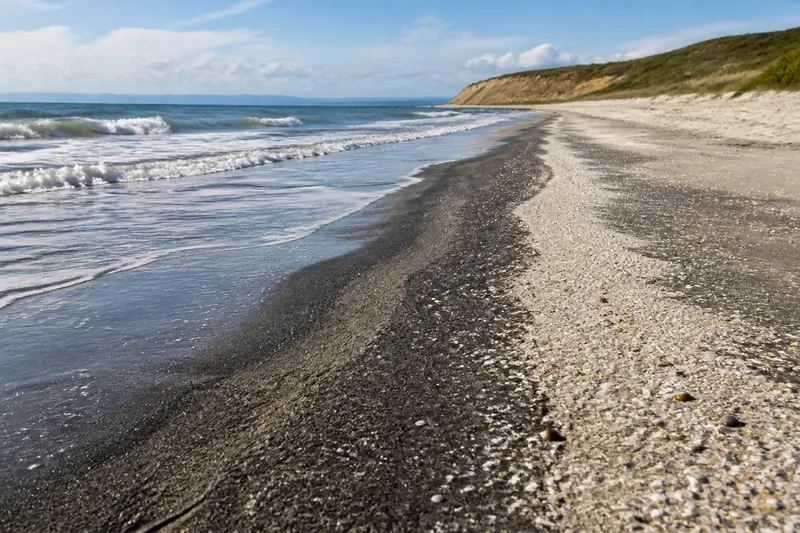
At the edge of the wash, a dark ribbon of damp sand lies beside a pale strip peppered with shells. Why sand grains sort themselves along a beach becomes easier to understand when you compare such small contrasts: moving water shifts particles unevenly, while changes in sediment supply leave different materials at the surface. These bands record conditions, not permanent divisions.
Visible patterns
Look across the shore before deciding what a band means. Is the difference mainly colour, grain size, shell content or moisture? A dark strip may contain finer, wetter sand, but it might also include dark mineral grains. Colour alone cannot distinguish those explanations.
Grain size offers a more direct clue. Fine grains feel smooth and can be carried in suspension by moving water; coarser grains settle more readily when the current weakens. Yet a beach surface is a mixture, and a few conspicuous shell fragments can make a patch look coarser than the sand around them.
Notice the pattern’s position, too. A band parallel to the waterline may reflect repeated swash and backwash. A patch around a shallow runnel may instead record water channelled through one part of the beach. Read the shape and setting together.
Begin by noting what differs: size, composition, dampness, or several of these.
Grain-size contrast
If adjacent bands differ clearly in grain size, water movement is a plausible sorting agent. Swash pushes water and sediment up the beach; backwash draws water down again. Because grains vary in weight, shape and resistance to movement, the two flows do not carry every particle in the same way. Some grains are picked up, some roll or hop along the surface, and others remain in place.
When water loses energy, particles settle. Coarser material may be left where the flow can no longer move it, while finer grains travel farther or remain suspended longer. The arrangement depends on the flow and the material, so fine sand does not always sit above coarse sand or at the water’s edge.
Look for a repeated transition rather than one isolated grain. If a narrow strip contains visibly coarser grains, compare it with the sand just above and below. A consistent change across the beach is stronger evidence of sorting than a lone shell or pebble.
Water movement
After calmer weather, small waves may have sorted the upper surface gradually. Repeated, modest swash can move loose grains without greatly reshaping the shore. The resulting lines may be delicate, and a later tide or fresh wave can blur them.
After rougher weather, look for broader changes rather than expecting neat stripes. Stronger waves can move sediment across more of the beach, expose coarser layers or leave mixed deposits. A fresh line of shells and debris may mark where floating material came ashore; it is not necessarily a grain-size boundary.
If the beach is crossed by runnels, inspect their edges and outlets. Water concentrated in a channel can carry sediment differently from water spread thinly over the slope. Grain bands may bend towards a runnel or gather near its mouth, making local flow a better explanation than uniform movement along the whole shore.
Match the scale of the pattern to the water movement visible nearby.
Local beach conditions
On an open, exposed beach, waves may sort grains alongshore as well as up and down the slope. The amount and type of sediment arriving from nearby cliffs, rivers or offshore deposits also matter. Two beaches with similar-looking waves can develop different surface patterns because their supplies differ.
In a sheltered cove or behind a headland, weaker or more variable currents may create patchier bands. Fine sediment can settle in quieter pockets, while coarser grains remain exposed where wave action is stronger. A small change in shoreline shape can redirect water and alter where material gathers.
Near a river mouth, the available mixture may change with rainfall and flow. A beach beside eroding rock may receive angular fragments unlike the rounded grains carried from elsewhere. These differences affect how particles move, so a pattern on one shore is not a template for another.
Material and moisture
If the contrast is mostly in colour, consider mineral composition before attributing it to grain size. Dark and light minerals can separate as water moves grains of different densities, even when the grains are similar in diameter. Shell fragments, organic debris and small stones may also form distinct patches.
Moisture can sharpen a colour boundary without marking a change in sediment. Damp sand usually looks darker than dry sand, and the wet edge shifts with the wash and drainage. Compare the texture across the line; if the material feels much the same, the apparent band may be a wetness boundary rather than a size-sorted deposit.
Say you arrive at a beach where a dark stripe runs parallel to the water. For this invented example, suppose the stripe feels damp and smooth, while a small comparison of grains from the stripe and pale sand beside it shows similar sizes; suppose, too, that dark mineral flecks are no more common in the stripe. You note the stripe’s position, compare its texture and particles with the neighbouring sand, then watch the receding wash. If the dark edge shifts with the wet area while the grain mix stays similar, dampness is the stronger explanation; if the edge remains in place and dark flecks are visibly more common there, composition is more plausible. Either result gives you an observable distinction instead of a guess based on colour.
When does a band indicate sorting?
Why do coarse grains sit together?
Coarse grains can remain where weaker flows cannot carry them, while finer particles are lifted or moved onward. But a coarse band can also reflect a local source, such as broken shell or rock fragments.
Does every dark strip contain finer sand?
No. Dark colour may come from minerals, organic material or moisture, and those can occur without a change in grain size. Compare texture and visible particles: a similar grain mix with a shifting wet edge points towards moisture, while a persistent concentration of dark flecks points towards composition.
Why do bands fade after a tide?
New swash and backwash can redistribute surface grains, while drying changes the contrast between wet and dry areas. A band may disappear even when the underlying beach materials remain much the same.
Can two nearby beaches sort sand differently?
Yes. Exposure, shoreline shape, water pathways and sediment supply can differ over a short distance. Those local conditions affect which grains move and where they settle.
Field observations
Use a simple set of observations to decide what to describe and compare:
- Check whether the band runs parallel to the waterline; if it does, compare its grain mix with nearby shore material, then consider repeated swash, while a bent or broken band calls for checking local channels or obstacles.
- Check whether grains look and feel finer or coarser than those beside them; if the difference repeats along the band, describe a likely grain-size contrast, while an isolated fragment calls for treating the patch as local debris.
- Check whether the band’s colour changes with wetness; if it shifts with the retreating wet edge and the grains look alike, describe a moisture boundary, while a stable colour patch calls for inspecting its mineral or shell content.
- Check for dark mineral flecks, shells, organic debris or small stones; if one material is concentrated in the band, describe a compositional contrast, while no clear concentration means colour alone remains inconclusive.
- Check whether water crosses the slope evenly or gathers in a runnel; if it follows a channel beside the band, consider local flow, while spread-out swash suggests a broader beach process.
- Check whether the band is narrow and delicate or broad and mixed; if it is delicate after calmer conditions, note gradual surface sorting as a possibility, while a broad mixed deposit after rougher weather calls for describing wider sediment movement without assuming a neat size sequence.
Careful interpretation
For a useful shore observation, record where a band lies, what its grains look like and whether nearby water flows across the slope or through a channel. Compare those notes with another visit under different conditions. The aim is not to assign every stripe a fixed cause, but to identify which explanation best fits its position and material.
Why sand grains sort themselves along a beach comes down to the meeting of particle differences and moving water, with local supply and shoreline shape setting the terms. When a pattern is ambiguous, describe it plainly—dark, damp, coarse or shell-rich—and leave room for more than one cause. That careful description remains useful after the next wave redraws the beach.